
the african country you’ve never heard of…
Unless, like me, you are fans of David Oyelowo and Rosamund Pike and have seen A United Kingdom. I meant to see it in a theatre but didn’t get there so was very excited when it was advertised and made special effort to watch it on television.
<We will get back to Panama but first a detour…>
It’s an inspiring story about tackling racism, establishing democracy, the evils of both apartheid and British colonial rule AND it’s a love story that will make you feel bad about your own life because they are so cool 😉
When I was very young, I had penpals in Ghana so I knew a bit about Africa for most of my life. In my twenties, one of my boyfriend’s best friends was really into Africa and humanitarian work so that really fed my interest. Another friend had this dream of going on safari in Africa. I thought that sounded like a great idea so I have now been twice and I think he has not actually set foot on the continent.
So I suppose you could say I am an Africaphile 🙂 When I married, I confessed to my husband my obsession with going on safari in Africa. He confessed it was a shared obsession but he would only do a luxus tour (he’s German). A luxus African safari sounded amazing so I started the research.
Lots of people go to Kenya or South Africa. They have done the best marketing themselves… but I am supremely analytical so every decision is vetted through a rigorous process. That is how I chose Botswana as our first safari destination. (If you are choosing, I am also a huge fan of Tanzania).
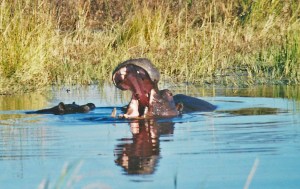
getting too close to the hippos
I picked Botswana because it was a good place to see wildlife but I always like to understand the places I am hanging out so knew a little before I arrived and then kept asking questions. It wasn’t all perfect. At least then (over a decade ago) there were problems with AIDS and moronic old-fashioned ideas that prevented an easy solution BUT it was an African country that made you believe in the future.
They had never been a colony (instead a protectorate, which you will learn about in the film) and had discovered diamonds as an independent country. They had embraced high end tourism and roads were not paved on purpose so that tour buses full of tourists couldn’t glide through the savannah.
It’s a magical place. We stayed in three different regions – the first safari by water on the Chobe River, then elephants all the time at Savute Elephant Camp and finally the phenomenal Okavango Delta where I discovered CCAfrica (hello Tanzania!).
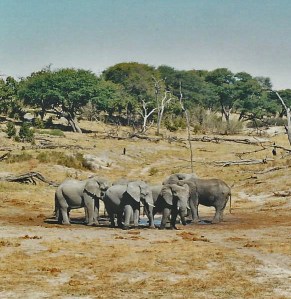
the view from my room
I cannot give proper coverage to Botswana in one post but this is just to get people thinking about it. While I was travelling around Africa the first time people said, “Africa will get into your blood. You will need to come back.” Even then I knew they were right. There are places that imprint themselves on your soul. There is so little wilderness left on our planet. I come from the western country closest to Africa and I grew up in wilderness. My grandmother was eating berries in the same patch as a bear…
Maybe it’s because I had part of my eyebrows singed on a May long weekend as a teenager fighting a forest fire and hoping we were NOT between the mommy and baby moose we had just seen close up that I feel so at home in the African bush. It feeds my soul and engages all my senses. As the African king tells the English insurance clerk, “the stars in my country take your breath away.” I’m not even sure that is the correct dialogue, just my memory of my own experience.
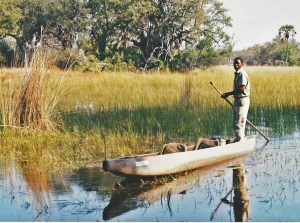
my first trip in a mokoro
A United Kingdom makes me want to go back to Botswana. These are supposed to be “once in a lifetime experiences” but they can be a bit addictive. Africa can be addictive.
Apparently I can thank Seretse Khama (and Ruth Williams) for that. I knew Botswana was special. It was Africa at its best. Such an amazing introduction. What I didn’t appreciate at the time was the backstory and how important Seretse was to the prosperity of modern day Botswana. He was certainly born with a lot of advantages most of us will never know but it seems to be a story of public service and leadership.
There is no question Botswana will blow your mind – potentially in several ways. You will need to save your pennies to see it properly but it will reward the effort. Every time people look at me blankly when I mention Botswana, I just say, “it’s because it’s an African country that WORKS. That’s why it’s never in the news and you’ve never heard of it. A perfect place for a safari? Obviously!”
A good place to start is to contact andbeyond or wilderness safaris.
Apparently, we can thank Seretse. I wish I had known more about him when I visited but back then, if google was a search engine, it was not THE search engine… I used dogpile! Why I should probably do a follow up trip 😉

 life on planetm
the beauty at the end of the world
Patagonia is not a land for wimps. I had been drawn to visit by a travel article that made the trip to Cape Horn sound like an adventure. The Australis team is very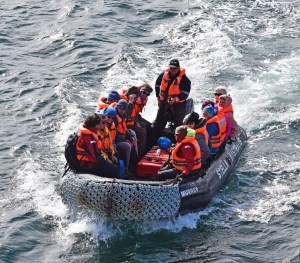 professional and you feel that you are in safe hands. It will be an adventure but draped in first world safety standards. Quite different to being trapped on a runaway elephant sans driver in the Thai jungle…
It was my first time on a zodiac though and I had seen enough of the Strait of Magellan by then to know I did NOT want to be in that water! First you are suited up in lifejackets. You then go through detailed instructions, which are repeated every time. It isn’t particularly difficult but you do need to follow the procedures to avoid tipping the raft. It’s an adventure for small-a adventure people. People who likely don’t swim with sharks, climb Mt Everest or paraglide over the Grand Canyon.
We all got on the zodiac without incident but everyone was pretty quiet and there wasn’t even a lot of photos being taken. No one wanted to tilt us into the Pacific Ocean. The zodiac driver employed only modest speed and tried not to scare us. I am always fascinated watching pampered first world travellers morph into greater adventurers. Even by the return trip to the ship, you could see people were relaxing on the zodiac and the driver gunned it once he knew we could handle it.
That was probably because the harder hike was indeed harder. By Navy Seal standards, a walk in a particularly pleasant park but we had been expecting something more 60+ friendly. Everyone made it but our tour leader just quickly led the way without paying too much attention if everyone was right behind her. There was enough elevation for heavy breathing and. in some places, you had to pull yourself up by grabbing a rope and making your way along its length, frequently through enough mud to destroy your footwear for any other future purpose.
There is a lot of time on the ship to chill out – or be brave and take photos in the frosty air. I did a lot of the latter. Luckily, I grew up in one of the coldest places on the planet so freezing my fingers off for a photo seems a fair trade-off.
In the afternoon, we got to put our zodiac skills to use a second time. This time we just cruised around a couple of islands admiring cormorants and penguins. It’s always amazing to see wildlife in abundance IN THE WILD in our over processed modern world. Patagonia has done a good job of maintaining its natural splendor.
cormorants posing for tourists 😉
Part of the credit goes to Doug Tompkins, one of those rare local hero types who can actually turn money made from being a good businessman to money spent actually doing something good for the entire world. He was the guy who created, along with his first wife, The North Face and Esprit. He first travelled to Patagonia in the 1960s and in 1968 did a famous trip with Yvon Chouinard (founder of Patagonia Inc.) where they put up a new route on Mount Fitzroy. Growing disillusioned of the environmental impact of the fashion industry, he channelled his Esprit profits into conservation.
yes I know I’m cute 😉
He moved to Chilean Patagonia. At first, he explored the wilderness of the region, eventually setting up the Foundation for Deep Ecology, The Conservation Land Trust and Conservacion Patagonia. He also married Kristine McDivitt Wear who had been the CEO of Patagonia Inc. North Face meets Patagonia… quite the love story.
Not surprisingly, they both shared the same retirement goals – land conservation, environmental activism and biodiversity. Tompkins used his retail riches to buy up land in Patagonia to save it from mercantile uses. This land grab by a foreigner was regarded with suspicion by locals. He was at various points accused of being a spy, of buying up land to create a Zionist enclave, and of planning to ship Chile’s fresh water to parched lands overseas.
Instead, his goal was to turn the land into national parks working with the national governments of Chile and Argentina. It appears he has made great progress in convincing everyone that there is benefit for everyone in creating national parks in Patagonia along with wildlife protection, biodiversity and sustainable organic farming practices. It all sounds a little too good to be true but go to Patagonia and see for yourself. The end of the world is a stunningly beautiful place full of fresh air and star-studded skies.
Sadly Doug Tompkins died in 2015 while on what he thought was an easy kayaking trip with a bunch of old friends. No doubt it was probably a manner of death he would have chosen for himself. Kristine continues on their legacy and the future looks promising. According to The Guardian, the Chilean government announced the day after Tompkin’s death that Pumalín Park, one of Tompkins’ earliest acquisitions, would become a national park in March 2017 but the website suggests that it is already open.
Writing about Doug and Kristine is a great antidote to thinking about the US election and how most of the rich people spend their money. I am incredibly hard to impress but Doug Tompkins goes on the hero board. What a wonderful world it would be if this is what all billionaires did with their riches…
Category:
life philosophy, shining examples, social commentary, travel stories
Tagged with: