
Going on a Hurtigruten ship is an experience in Norwegian history. It is the only Norwegian word I really know – “hurtig” means fast. It all came about in 1893 when a young entrepreneur named Captain Richard With left Trondheim on a steamship named “Vesteraalen” sailing into Hammerfest to a cheering crowd in 67 hours – a half hour early!

the view in the rain…
When Captain With took the challenge to create an express boat service between Trondheim and Hammerfest, there were only two marine charts and 28 lighthouses north of Trondheim. He was a pioneer in Norwegian history and helped to foster the economic powerhouse that is modern day Norway.
Ships have been operating on the Coastal Express for over 100 years. Since 1936, a Coastal Express ship has left Bergen heading north every day – with some minor interruption when Norway was occupied by the Nazis of course. The names of the Coastal Express ship company has changed over the years, from Vesteraalens Dampskibsselskab in 1893 to the much easier to pronounce Hurtigruten today.
I’ve almost finished my journey so we’re going back to nostalgia mode now. Leaving Bergen is dramatic. These are lots of excursions you can take from the ship and I think it’s worthwhile to research them before you leave home and decide what is most likely to rock your boat. Nothing is cheap in Norway so I decided to just see what I could see from the ship – a mini adventure. Some people have booked the excursions just so they have someone to guide them back to the ship. It really depends on how good your sense of direction is. The towns are pretty tiny though so it’s not hard to find your way home.
If you go on the excursions, the days will likely feel much more hectic. If you just follow the ship’s timetable, there is lots of downtime. If you go later in the season, it’s likely fun to hang out on deck or pop into the Jacuzzi. It’s not a cruise ship so there aren’t many activities on board but there is lots to see out the window and you can eat and drink pretty much all day and night. Internet is not 21st century but you can generally find a signal. And you can always pile on your fleece and walk around on deck 5 to snap photos without glass in the way.
Your first stop will be Alesund. If you’re lucky, it will not be raining. I was not so lucky but persevered and found my
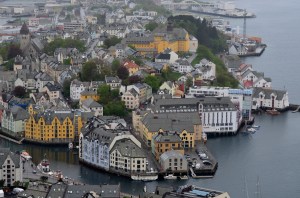
view from the top of the 418 steps!
way (after a few false starts) to the 418 steps to the top of Aksla mountain. It wasn’t too bad but I was breathing heavy for the last 50 steps. People coming down encouraged me to keep climbing, saying it was worth it – so I did the same for other tourists when it was my turn to come down.
It is worth it, even on a rainy day. I can imagine it would be glorious on a sunny one. Alesund is definitely worth checking out. Norwegians are keen on building wooden houses – and then burning them down it seems. I guess it gets boring in remote places…
The town of Alesund burnt to the ground in 1904 so was rebuilt in the Art Nouveau style, making it one of the more intriguing cute towns in Europe. This is also a gateway to the Geiranger Fjord I gather – but not until June…
Perhaps I will return someday when the sun is shining and boats are sailing in the Geiranger Fjord? 🙂





 life on planetm
kids on a rope :)
There is a short list now of places that I absolutely MUST see and it’s one of those wonderfully pleasant dilemmas each year deciding which destination (maybe two if times are flush) will be knocked off the list.
I have had some wonderful adventures by visiting a place at a special moment in its history so I decided to finally see the fjords since 2014 would be Norway’s 200th anniversary. And I would start in Oslo on May 17th to see the National Day up close and personal.
It’s definitely a worthwhile endeavour. I think I saw every school child in Norway! But it may have just been all the children in Oslo.
That is the focus of the day. There is a children’s parade to the palace where they are greeted by the king and queen of Norway. I think I saw them waving on the balcony but I was just floating with the experience so I am sure better preparation would have allowed a closer royal sighting. But I think monarchies in the 21st century are dumb so…
following the locals 🙂
I was excited to manage to score a good spot for the parade despite not even being clear on where the parade route was. The hotel staff were vague (I gather no one bothers unless they know kids in the parade). The tradition is to dress up in traditional costumes so I just followed a group looking as though they had stepped from 19th century Norway out of the hotel until I saw a big crowd, where I parted company with the people in fancy dress in case they were going somewhere the bouncers were checking for embroidery instead of designer threads.
I managed to get a great view of the parade and sported the sunburn for a couple of days to prove it. (Do recommend a hat if you watch the parade!) It goes on for a long time. I can understand Norwegians shunning it after a few years. But there are lots of small children. While not every child is in traditional
wave that flag!
dress, almost everyone looks festive.
It’s a very cool experience as children are inherently entertaining. But what is also really heartwarming about 21st century Oslo is the inclusiveness of the society.
Sunday is the day to go to the National Gallery. It’s free! Free and Norway are not concepts you normally put together … but on Sunday you can see The Scream, antique furniture and thought provoking modern art all for free!
Combined with the parade, it offered some insight into Norwegian culture (the history is still a bit murky – plan is to clear that upon my return to Oslo). One of the museums proclaimed Norway the “peace nation”. And this is where you can score a Nobel Peace Prize.
I love nations with a smart agenda. I had envisioned Norway as one of those countries that was beyond post-modern – a country of the future. It has not disappointed. The museums were interesting and provocative (a big emphasis on human rights and free speech) but what was most gratifying to see was the diversity of children included in the National Day parade.
The whole world was represented. Not only different skin tones but different facial features. Some wore traditional Norwegian dress, which really warmed my heart. I think immigration is a total force for good. But, if you change countries, you should be madly in love with a foreign national or madly in love with what that foreign country represents. Some countries posit better concepts than others. If you like your own culture, stay put. Immigration works when people come to a new place for the right reasons.
I haven’t met enough people yet to have a solid prognosis on 21st century Norway. But I have never seen such a variety of foreign faces in a European country. And everyone was included – a handicap did not exclude you. You just had someone pushing your wheelchair.
a rope of the world 🙂
The small children were attached to a rope to deter wandering. But the diversity of the rope gave one hope for the 21st century. As does the fresh air. Go Norway! I think there is much the rest of the world can learn from these reformed Vikings 😉
Category:
shining examples, social commentary, travel stories
Leave a comment
Tagged with: