a unique perspective on this crazy world

going native…

Staying at the Hotel Parque Central put me firmly in gringo tourist land, an obvious mark flush with hard currency.  Tourism has turned Cuba into a fascinating hybrid culture with lots of unexpected consequences.  There is idealistic merit in having all jobs paid a similar wage but, in 21st century capitalism, the approach is completely opposite.  Cuba’s model might work if it could exist as a self-sufficient closed society but instead it had to let in the rest of the world in limited ways to survive.

The unexpected consequence is that it might be more lucrative in 2017 to drive a taxi than to be a doctor.  How to behave as a tourist is complicated but you will definitely get constant sales pitches if you stay in the tourist ‘hood.  I always like to try and understand the places that I visit and one of the best ways to get familiar with unfamiliar surroundings is to walk.

Luckily Havana is very safe so you can wander quite freely and it’s likely you can find a taxi to get you back to the hotel if you get too ambitious.

My first big Havana adventure was supposed to result in photos of Plaza de Revolución but everything unfolded in an entirely unexpected way.  According to the map, I could just walk in a straight line along one of the main streets until I reached VedadoVedado (`forbidden`) was originally a buffer zone to protect the city from pirate attacks.  In 1859, a plan for urban expansion was created with strict building codes that established a grid with broad sidewalks, gardens and parks.  There are few tourist sites but it is a great way to experience middle class Cuba.

It is also the home of the University of Havana.  I stumbled upon the university by accident rather than design but it is one of the oldest universities in Latin America with gorgeous classical buildings and historical significance.  I stopped to take a photo of the university entrance and that was how I met Rolando.  He said that the views were better from inside.  Since he is a Spanish professor at the university, he took me on a grand tour.

Unfortunately, it`s not an official tourist activity so you will just have to get lucky.  It`s definitely good to talk to locals to get a better understanding of the complexity that is modern day Cuba.

I ended up spending a few hours with Rolando.  First, he toured me around the university, including the Museo Anthropologico Montane, the Saracen armoured car captured in 1958 by students in the fight against Batista and the balcony from which Castro delivered speeches to incite students toward revolution.  Then he showed me the room Castro rented when he was a student.  He explained the ration system for food and took me into one of the stores where Cubans can exchange coupons for food items.
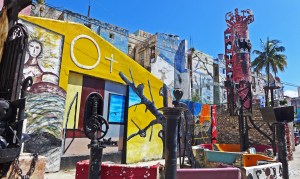
creative recycling

creative recycling

Rolando then took me to a cool neighborhood filled with impromptu performers and art made from stuff that would likely go into a landfill in North America.  Our final venture was a cocktail based on an ancient recipe in a tiny, funky bar.  Latins love sugar a lot more than me so it wasn`t really my thing but the experience was memorable.
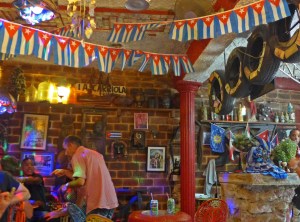
off the tourist path

off the tourist path

He had to go to work so gave me directions to the Plaza de Revolución but I never figured out Vedado as the streets are not marked in a normal way.  It`s a pleasant place to get lost so I just went with it and finally found a major street that I could locate on the map so that I could eventually make my way from la Avenida del Presidentes to Calle 23, also known as La Rampa, and one of the most famous streets in Havana.
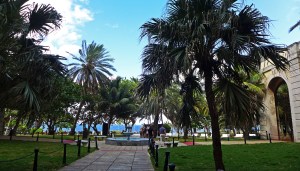
hotel-nacional

living la dolce vida

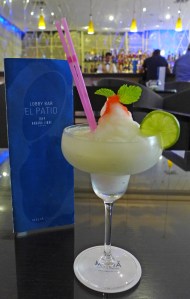
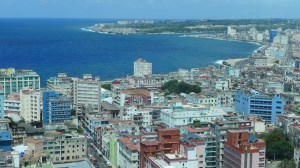
That`s where I rewarded my hours of wandering on foot through Havana with the beautiful frozen daiquiri previously mentioned.  It also allowed me to get a good overview of Havana and figure out where the Hotel Nacional was by looking out the window!  This time I counted the streets very carefully and make it to the new destination without any extra steps.  The Hotel Nacional was built in 1930 as a refuge for wealthy Americans.  Since it has hosted a cornucopia of famous people and featured heavily in the history of the mafia.

It also features a delightful terrace where you can sip an overpriced drink and look out at the ocean and much of Havana.   By that point, I was content to head back to tourist land and pay for a taxi.  All the wandering though made me bold and encouraged me to delve further into the real Cuba…


viva la revolution!

It is strange and somewhat disconcerting to be a tourist in a Communist country.  Of course, you can just follow a tourist guide around and not think about it or stay in a posh resort that is wholly capitalist despite the national politics.  I always like to try and understand a place when I visit to the extent my few days immersed in the local culture will allow.

drifting through havana

drifting through havana

Since I only had about five full days in Cuba, I decided to just stick to Havana so that I could try and get a good sense for it and save the rest of Cuba for another visit.  There is plenty to do – and think about – in Havana so I was never bored.  I also went on these crazy walks all over Havana that lasted for hours and frequently resulted in me being lost for some portion of the walk.  The wonderful part of that was that I discovered Havana in a way I never would have just speeding by in a pretty refurbished automobile from the era of Trump’s fantasy America.

I did feel that I should do that at least once, and since I had gotten lost trying to walk to Plaza de Revolución, it seemed a

an eerie place

an eerie place

good case for a fancy ride through Havana.  I would definitely recommend at least one ride in a classic car.  Mine was very expensive compared to everything else in Cuba but, as a gringo, I just accepted I was contributing to the economy.

Plaza de Revolución is a lot different in person that it looks in photos.  There is the fancy metalwork saluting Fidel and Che, which is a compulsory tourist photo.  The square is gigantic and generally eerily empty.  The military presence is very obvious and you realize you are in a police state.  It feels like someone is watching from a hidden camera every moment.  There are lots of signs marking where you can no longer wander.

welcome to china!

welcome to china!

Communism and other forms of dictatorship make me nervous.  I was relieved to get out of the Plaza de Revolución and to another part of Cuba that felt hopeful and festive.  When I was in China, my hotel was close to Tiananmen Square and, despite being a major hosting venue for the Olympics, which had just ended, no taxi driver seemed capable of finding it so I spent a lot of time in Tiananmen Square.  It is an unnerving place to be deposited.  Mao is always looking at you and there are plenty of dudes with rifles milling about.  One of the most bizarre sights was the soldiers standing guard in front of a giant display of the silly Olympic mascots.  There should have been a sign saying “Welcome to China!  It’s complicated.”

All countries are complicated but Communist countries increase the complexity by an exponential degree.  Theoretically, all this communism is FOR the people and offers them a better life than the capitalist pigs would have allowed.  But it’s never really gone down like that.  Every supposedly Communist state is a little different.  ALL love propaganda!  All are comfortable suppressing the truth, controlling the media and rewriting history.  Visiting a Communist country really makes one appreciate the freedoms and benefits of democracy even if not all of its attributes are sublime.

When I was in China, it was entertaining to read the history of Shanghai through the Chinese government’s eyes.  In Cuba, you can get the same experience by visiting the

ya gotta love propaganda ;)

ya gotta love propaganda 😉

Museo de la Revolución.  It is located in the former Presidential Palace so worth visiting just for the architecture.  You will certainly learn about the Cuban Revolution.  You won’t learn much beyond that, though, and it’s all glory and sacrifice and the 1960s.  Just another aspect of Cuba that feels like a time capsule.

fidel is watching you...

fidel is watching you…

It’s important, though, to note that young Castro was a noble guy.  He did some good stuff.  It’s easy to go communism bad, capitalism good, but it’s not at all that simple.  Probably why the vast majority of the people who score high on happiness and quality of life on those international indices live in socialist countries. The best system includes elements of both.

And Castro and team did some remarkable things in Cuba.  They defeated the United States of America!  They got rid of the mob and the casino culture that had overtaken the economy.  They sent young disciples out to rural Cuba to teach everyone how to read so that Cuba now has one of the highest literacy rates in the world.  They also have free education and healthcare and some basic food is provided by the state.  It’s an idealistic concept that would have appealed to the very young men and women who masterminded the Cuban revolution.

The tough part, though, is how to sustain that kind of system and how to be able to interact with a world that doesn’t share the same system.

the iconic che

the iconic che

The original system was more crazy fever dream than well-reasoned new political and economic philosophy.  As an example, I learned that Che Guevara was appointed President of the National Bank of Cuba and Minister of Industry in addition to being in charge of Agrarian Reform.  OK, first, TOO many major jobs.  Second, SERIOUSLY, who appoints a dude who’s a doctor and a guerilla war expert to run the money stuff???

I would encourage you to go to Cuba and check it out for yourself.  Go with an open and inquisitive mind.  There are some good ideas there.  There is a lot of idealism.  There is a lot of pride.  There is also naivety.  Cuba is an example of incredible idealistic ideas brought to fruition – but it is also a cautionary tale that it’s really important to have a plan that’s sustainable and pragmatic enough that your revolution will actually achieve the ideals you hoped it would for the long term.  The hardest part begins the day after the victory parade…


I still have a little more to say about South America but decided it was time to change locales for a few posts…

You may recall I bumped Cuba up the travel list because I was worried it would be flooded with Starbucks before I got to see it the way I had always romanticized it.  Of course, all that is in question now, which means making a visit soon is likely not as urgent but I would still encourage it.

While I love the internet, it has been responsible for the commoditization of global culture.  I first noticed this in the twilight of the twentieth century when most people still hadn’t figured out how to use the internet.  Even then there was global media, cheap travel and far easier ways to share ideas than had ever existed before in human civilization.

As someone who grew up in the middle of nowhere and dreamed of having access to what was actually going on in the rest of the world, it was exciting.  I was also able to start travelling a lot and quickly understood that it also meant that so many places looked alike that had once been unique.  The trendy bars in Sydney, Paris and San Francisco all looked shockingly similar, devoid of elements that made them reflect their unique local cultures.

What I discovered is that if you got a little more adventurous, you could still find something that surprised you in a delightful way.  It might be in Cambodia, Tanzania or Romania.  It was likely to always be in an emerging market.

In Cuba, things go a little further.  Not only is it unique but you feel like you are visiting history without a time machine.  In Cuba, Fidel, Che and Ernest are still in their prime.

It feels a bit like you are on an acid trip (or how I imagine an acid trip would unfold 😉

There are several shrines to Hemingway.  Pretty much anything associated with Hemingway has a plaque at minimum.  It’s very surreal as there is almost no advertising or promotion in Cuba – except when it comes to the big three.  Coming from a market economy it is both comforting and disconcerting.

But you can just go with the kitsch and not obsess over its moral implications 🙂

worth the price!

worth the price!

One place you really should hit is El Floridita.  It’s been around since 1817 and about 100 years later it acquired a new Catalan immigrant owner, Constantino Ribalaigua who invented the frozen daiquiri in the 1930s.  Neither he nor the daiquiri may have become so famous had it not been for one of his patrons – Ernest Hemingway.

These days there is a bust of Hemingway along with memorabilia and a lot of tourists!  It is the most expensive daiquiri in Cuba (but still cheap by first world standards) and absolutely worth it.  It’s a daiquiri factory still set in the 1950s.

If you are a Hemingway fan, you can also try a mojito at La Bodequita or just hang out at Hotel Ambos Mundos where Hemingway was a resident from 1932 to 1939.

If following Fidel is more your thing, you should head for the Hotel Habana Libre.  It originally opened in 1958 as the

it's 1960 in havana

it’s 1960 in havana

Havana Hilton with Conrad Hilton himself in attendance.  At the time it was Latin America’s tallest and largest hotel and likely the swankiest.

On January 8, 1959 Fidel took residence in suite 2324 as his headquarters.  In October 1960 all American hotels in Cuba were nationalized and the hotel was renamed the Hotel Habana Libre.

a daiquiri worth seeking out

a daiquiri worth seeking out

It’s now owned by the Spanish Melia chain and a great place for a fantastic daiquiri – the best I

the view!

the view!

had in Cuba and about half the price of El Floridita.  There is also a nightclub on the top floor but it wasn’t open when I stumbled upon it on my walk around Havana until you figure it out unofficial excursion.  I was hoping to get a drink and take cool photos of Havana.  Luckily I shared my goals with one of the hotel employees and she took me in an old-fashioned operator controlled elevator to a high floor that felt like something out of the Jetsons.

You can live in the past – or at least visit it 😉  I highly recommend exploring the past and present intermingling in one of the only places left in the world where that experience is still possible.

cape horn or bust! ;)

Our final day on the ship was appropriately dramatic.  The hopeful climax of the cruise is to be able to embark at Cape Horn.  Cape Horn is the southernmost tip of South America and a legendary place.  If the weather in Patagonia is challenging and unpredictable, the weather and sea surrounding Cape Horn takes it up a few levels.

Sailing around Cape Horn and then through the Drake Passage is one of the most challenging nautical routes on the planet.  The waters between South America and Antarctica are plagued by icebergs, gale force winds and giant waves.  The opening of the Panama Canal was not great for Patagonia but saved the lives of many sailors.

worth the hike

worth the hike

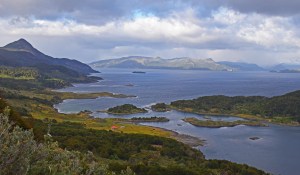
We began our final day on the ship with a less daunting initial destination.  This time I decided to sign up for the medium hike instead of the hardest one.  We got to walk in the footsteps of Charles Darwin, going ashore at Wulaia Bay.  He did his walk through the Magellanic forest on January 23, 1833 but it likely hasn’t changed much since then.

My fitness had obviously improved a little and I was hot on the heels of the guide the entire hike.  It was a decent hike with enough vertical for some heavy breathing showcasing the native flora and fauna, including the reward of a panoramic view of Wulaia Bay at the top of the hill.

This was also one of the largest settlements of the original inhabitants of the region, the Yamana.  There is a small museum which features exhibits on the history of the Beagle Channel (including Darwin and Fitz Roy) and the Yamanas.  Lots of controversy amid the human achievements in science and navigation – the progress of civilization is never a simple and straightforward path.

Prepare some photos to submit to the slide show that will part of the final night’s entertainment and wait for us to reach Cape Horn.  I watch the weather and it doesn’t look promising.  The water looks really choppy and the sun doesn’t magically appear calming the sea.

We are all herded into the lounge for a briefing about Cape Horn.  We are shown a video and instructed on what to do if the zodiac

testing the waters

testing the waters

starts to fill with water.  If the conditions aren’t safe, we will have to fly the pirate flag in lieu of an actual excursion and Cape Horn photo shoot.

We all wait around anxiously as a small team of experienced staff members is sent out in a zodiac to test the waters and report to the captain on the conditions.  It looks challenging but the captain says it’s a “go” so we don’t want to miss the opportunity.

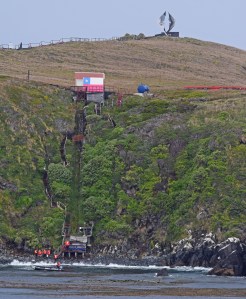
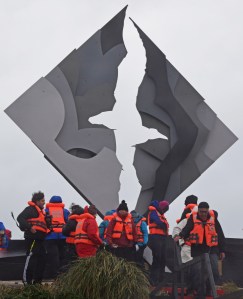
The zodiac rides are slower and more somber but we manage to not take on water so it’s only a small adventure.  I pile on all the warm gear I brought – the polar worthy fleece, thick gloves and a wool hat I bought in equally weather challenged Iceland.  It was totally worth the space in my luggage!  The wind is blowing so hard we can’t go into the lighthouse but we can climb up the stairs and take photos with the wind battered albatross that marks the spot as Cape Horn.

cape horn!

cape horn!

The Cape Horn Memorial was erected in 1992 to honour all the sailors who died trying to round the Cape.  The albatross is supposed to support winds of 200 kilometres per hour but there has been some damage already from the wild weather and it’s a little crooked in places but still impressive.

Our voyage ended with a delicious dinner, the group slideshow and more people hanging out at the open bar.  The Germans I had met the night before gave me a hard time for not doing the hardest hike and I had a lovely conversation late into the night with Lee from England.

One of the trips that had been floating in my imagination for over a decade was complete.  I would have loved better weather but it was still spectacular and worth the journey to the end of the world…


not for the faint of heart…

So we will head back to Chile for a little while at least… I have so many travels that have not yet made it to the blog but will try and catch up in 2017…

I grew up in parts of Canada that feel a lot like Patagonia so I was ready 🙂  I also packed a lot of fleece with varying levels of warmth.  As previously noted, I wore everything that I packed.  I did end up tantalizingly close to Antarctica so the adverse weather shouldn’t have come as a big surprise.

One of the biggest surprises in Patagonia and Tierra del Fuego is that the weather is famously unstable and unpredictable.  It did not disappoint 🙂

pia glacier in the rain

pia glacier in the rain

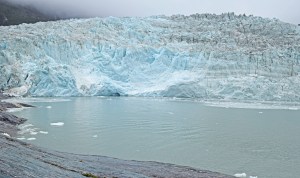
As you will have seen from the photos, the first day aboard the Australis ship was brilliant in every way.  On day two, we still had the same impeccable service but the weather had turned against us.  There was only one zodiac excursion, a soggy trek on the Pia Glacier that was still magnificent even in the drizzle even if the photos wouldn’t show it in its glory.

We didn’t get to witness a huge chunk of ice breaking away from the glacier and rushing into the sea but we did see remnants of recent activity and hear rumblings.  The most fascinating part was how even the murky light played with the textures of ice on the glacier creating stunning kaleidoscopes of ice, shade and sunlight.

ice as art

ice as art

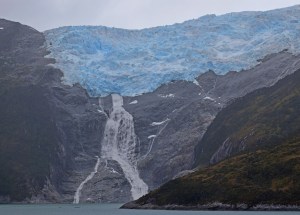
There was a second event that day but it didn’t require us leaving the ship.  We entered the Beagle Channel (named for Charles Darwin’s ship The Beagle).  This brought us into Glacier Alley.  This is definitely something you would want to see under better weather conditions.  I tried to take photos but it was a bit like my famous photo of the Matterhorn in the fog.  I KNEW I HAD seen it but it was hard to convince anyone else 🙂

entering glacier alley

entering glacier alley

The glaciers are spectacular so they still look compelling in the rain under freezing temperatures but running outside to try and get a photo of them isn’t pleasant and feels a bit futile.  Nevertheless, it was a fun experience.  It’s all rather imperialist but each has a European identity – Spain, Romanche, Germany, Italy, Holland, France.  Each is a bit different in character and the ship served cheesy stereotype food as we passed each one.  The food may not have been creative but that doesn’t mean it was bad and it made the whole experience more entertaining – particularly since the weather was so terrible.

In the evening, they screened an interesting film about Shackleton.  It resonated a lot more when you have spent the day in chilly waters full of glaciers.

The other interesting experience that day was that we actually saw another ship!  The Beagle Channel is wider so conventional cruise ships can traverse it.  It reminded me of how special our journey on the Australis was.  We weren’t Darwin or Shackleton but I did feel very far from the populated world enroute to the farthest reaches of human civilization.

the evolution of toronto

We will get back to Chile but first a little more on Toronto.

Toronto is the largest city in Canada and, even decades ago, when I made my first visit and the population was considerably smaller, it was an overwhelming place.  I was fortunate in that, in the early days, I always had local guides.

As a child, Toronto seemed as remote and glamorous as Oz and I had no idea how I was going to get there – just that it was a goal.  My interest was further piqued when I met Nancy who was visiting relatives in my remote middle Canada small town.  She didn’t actually live in Toronto but rather in one of the bedroom communities surrounding it.  A trip into the city was no big deal.  We became pen pals and I plied her with questions about the city.

My first Toronto guide was Marissa.  Somehow my Toronto stories always begin elsewhere.  Marissa was living at student residence in the University of Calgary that summer.  It was a popular accommodation choice for students with well-paid jobs in the oil industry.  She was Italian, the first I’d really known.  The Prairies are too cold to attract many immigrants from sunny climes.

At the end of that summer I was heading to London, Ontario to attend the previously mentioned fancy business school so would be about a two hour train ride from Toronto.  She invited me to visit and stay with her family in Downsview.  The Prairies are scarcely populated.  Not all countries are represented but there is a lot of diversity.  Lots of people have several different national groups in their DNA.  Toronto is different.  There are enough immigrants from certain countries that they can band together and create a replica of the old country within the new.

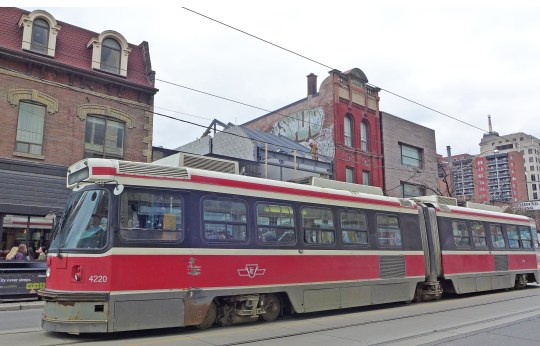
toronto-iconic-streetcarSo I was introduced to Toronto by way of Italy!  Marissa was first generation.  The house was decorated with lots of Roman looking knick-knacks.  We ate Italian food.  We went to the neighbourhood bakery to pick up cannoli.  There was great controversy because her brother’s girlfriend was Jewish.  I wasn’t used to cultures with so many rules.
That’s when I discovered there were all sorts of cultural communities within Toronto.  Almost any cultural group had enough members immigrating to Toronto that they could band together.  Often a few people started the pattern and then others followed because they knew there was a community to welcome them and immigration would be less daunting.  The early arrivals established a safe place, which attracted new arrivals looking for a mix of new opportunities and familiar tastes and smells.

Modern day Toronto is possibly the most multicultural city in the world.  About half the population is composed of immigrants and over 200 ethnic groups and 140 languages are represented.  This means that Toronto is full of festivals and events.  If you are OK with crowds, that’s when I would come.  There are festivals for almost any interest you might have.

One of my most significant festival memories was a festival called the International Caravan.  Apparently, it died out in 2005 and it wouldn’t be the same even if it did still exist.  In those days, Toronto was smaller and it was phenomenally safe for a large city.  Its nickname was “Toronto the Good”.  The concept of the International Caravan was to get a passport and go to national associations all over the city to try the food and see the music and dance of the old country.

The festival was created in 1969 to try and bring together the various national groups who tended to live in their silos in different communities.  I went to my first Caravan the first year I actually lived in the city.  My boyfriend had grown up in the city and we journeyed all over town, walking countless blocks, even to neighbourhoods with a shady reputation.  Sure, there was haggis and elaborate Ukrainian dancing and I was young and desperate to learn about all the countries I couldn’t yet afford to visit but what it really taught me was that there were all these different neighbourhoods, each filled with a unique character developed by the melding of all the cultures that had settled there.

1985 Toronto was a harbinger of 21st century Canada.  21st century Toronto is a city where you experience the entire world.  Next year is Canada’s 150th birthday so the celebrations are likely to be better than ever.  Check out a festival.  Or just pick a neighborhood and wander.  That’s where you will find the real Toronto, the one that left such an imprint on my life…

since Canada is trending ;)

I’ve been travelling all over the world as a Canadian for a long time.  It’s not a bad passport to have.  People generally have a favourable view of Canadians but they generally don’t know much about Canada, probably assuming it’s just America with fewer guns.

I’m OK with people not knowing much about us.  One of our virtues is that we are understated and polite.  It was refreshing to see the patriotism first hand at the Winter Olympics in 2010 but I hoped it wouldn’t change us too much.  What I saw when I saw the photos was how integrated and multi-cultural we were.  We are no longer a country full of white people and most people are cool with that.

I grew up just as Canada was starting to embrace multiculturalism so that has been part of my cultural identity my whole life.  It’s partly what makes me a great traveller.  I was taught to be curious and respectful of other cultures and to seek out interesting festivals and customs.

I am better able to represent Canadians than the average passport holder because I have seen most of the country and lived in five of the ten provinces, in both big cities and small towns.  I have had friends or family living in the missing provinces and territories so I have a strong sense of the country as a whole entity, not just my own backyard.

It’s my great familiarity with my own country that makes me think of it as “home” rather than “travel”.  I was just in Toronto recently and one of my friends there asked why Toronto never made the blog.  I told her it was on the list but it always got punted by a more exotic locale.

But since Trump has sparked interest in Canada and next year will be the 150th anniversary of our confederation, I thought it was likely a good time to write about Canada 🙂

I know a LOT about Canada so will certainly post more once I get some of the other travels caught up but, for now, we will talk about Toronto since I was a genuine tourist there twice this year.

My first serious boyfriend grew up in Toronto.  I met him in Calgary.  By that point in my life, I had managed to get to London, Ontario to go to a very fancy business school.  Toronto is the “big smoke” in Canada.  They used to share the power with Montreal until they passed Bill 101, making French the official language, and sending the English speaking elite to Toronto.

As a child, I spent a lot of time talking to my father who was surprisingly cosmopolitan in matters of business, history and politics so he seeded the dream that one day I would work on Bay Street (the Canadian equivalent of Wall Street).  Just the idea of GETTING to Toronto seemed an impossible dream in those days.

And the truth was that I wasn’t really prepared for it.  But I was lucky.  Michael was an extraordinary guy and introduced me to the city of his birth in a way that inspired and empowered me.  Toronto was where I came of age.  Where people started to think I had grown up in the city – not knowing how to clean a seed drill.  The transformation wasn’t instant but Mike allowed me to feel confident enough in the big city that I could eventually feel confident anywhere.

I’ve lived in Toronto twice and have had friends move there at various stages in their careers so it has been a constant presence in my adult life.  My most recent visit really demonstrated how tied I am to the city – celebrating the 21st birthday of the daughter of one of the friends I made at the fancy business school.  Why it’s so hard to approach it as a tourist.  Toronto to me has some of the same allure Montreal has for Leonard Cohen.

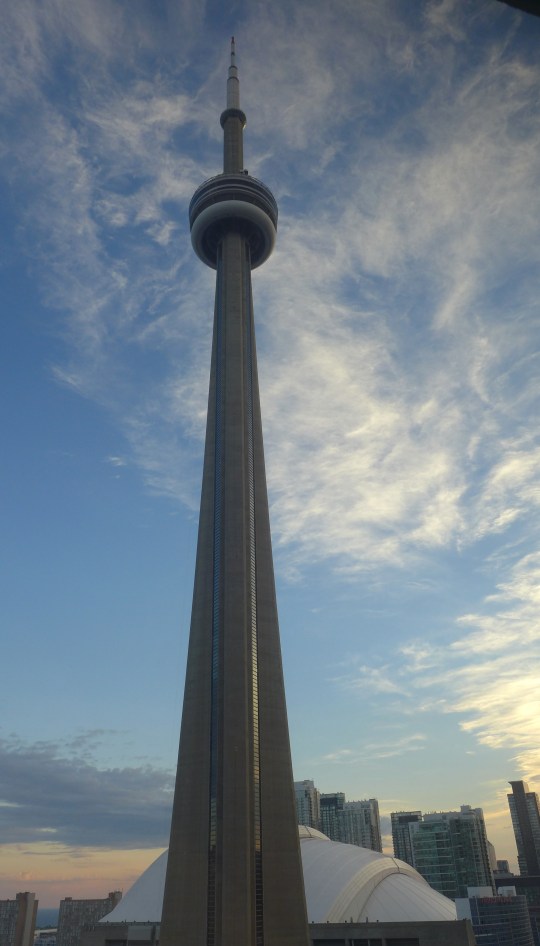
cn-towerToronto doesn’t have a ton of sights and must do’s for tourists.  That doesn’t mean it has none, just that it isn’t New York, Paris or London.  Its most famous attraction is the CN Tower.  It was completed in 1976 and was the world’s tallest tower at the time.  The record held until 2010 when Asia got rich.  It is definitely worth a trip.  My most memorable trip up the tower was on a rainy day where the rain changed to snow by the time we reached the top of the tower.  It appears there are a few other options now and I may need to relive the experience on my next visit to Toronto.  It also looks like the revolving restaurant at the top of the tower is a lot more sophisticated.  And for the daredevil, you can go on an EdgeWalk around the tower.

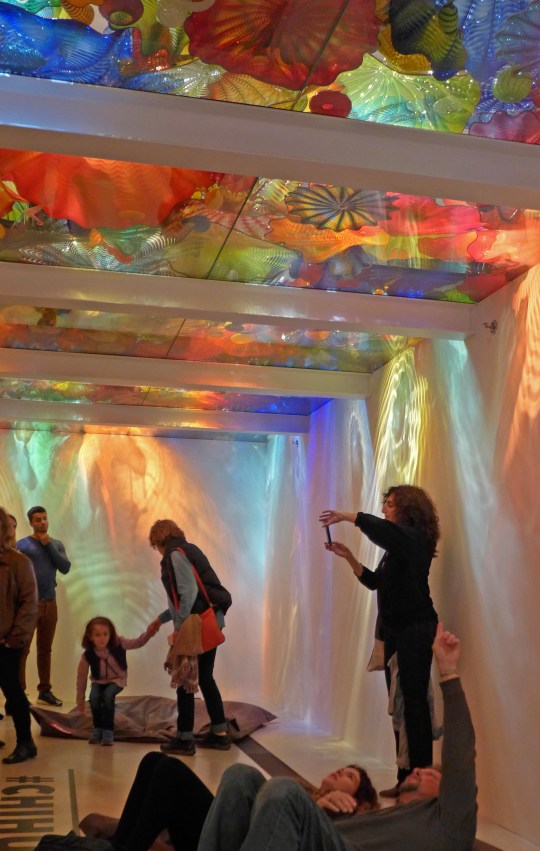
mind blowing chihuly

mind blowing chihuly

Another place tourists should check out is the Royal Ontario Museum (ROM).  Given that there were a lot of dinosaurs ACTUALLY roaming around in Canada, that part of the museum is especially impressive.  The ROM also hosts a series of intriguing temporary exhibitions.  Until Jan 8, 2017, they are hosting an exhibition of Dale Chihuly’s phenomenal glass work.  It is spectacular!the-very-popular-persian-room

The other place I would send tourists to in Toronto is Casa Loma.  It has a long and turbulent history, which is as interesting as the estate itself.  Canada doesn’t have many robber barons and their spoils but Casa Loma defies that stereotype.  Henry Pellatt was a financier at the dawn of the twentieth century and bought up 25 lots of land on a hill from developers in 1903 and then engaged 300 workers to build a dream estate in Gothic style.  History wasn’t kind to Casa Loma.  First, World War I and then the Great Depression…  In 1933, the city seized Casa Loma for back taxes, which is why you can visit it as a tourist.

There are other formal tourist attractions as well.  If it is a first visit, the best is to buy a City Pass.

MY Toronto, though, isn’t the stuff on a City Pass.  There is a lot more to the city than is obvious as you step out of Union Station.

A topic for another post 😉


Tag Cloud