
it’s all about the canal!
finally, a blog post!
If you were playing word association and the first word was Panama, the next invariably would be Canal. The Panama Canal is an engineering marvel. Panama is probably the most famous isthmus in the world. It was discovered in 1513 by Balboa. That began the canal debate. As we’ve talked about in the Chile posts, ships had to make a long, expensive and dangerous tour down the Americas, past Cape Horn and back up the other side before the Panama Canal. Eliminating all that extra time by crossing between the Atlantic and Pacific through Central America was obviously a great commercial idea.
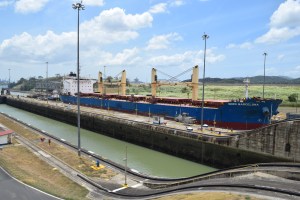
checking out the canal
The challenge of course is that Panama is largely rainforest. The French started the project in 1880, encouraged by the success of the Suez Canal. Count Ferdinand de Lesseps, the builder of the Suez Canal, started a sea-level canal. Panama was not Egypt. Rather than desert, it was largely rainforest and the rain caused landslides and yellow fever and malaria killed thousands of workers. In 1888, the French gave up.
That’s when Teddy Roosevelt got involved. Until you come to Panama, you will likely not appreciate that it is very close to Colombia and was a Colombian territory until 1903. The US had purchased the assets in the canal zone from the French in 1902 for $40 million. Thus began a bizarre colonial relationship and lots of American meddling in Central America. Colombia wasn’t happy to have the USA building things in its territory so the US decided to support a Panamanian independence movement and Panama became an independent country in 1903.
This gave the US tremendous control over Panama and the Panama Canal.
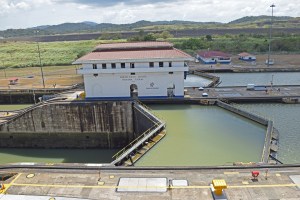
miraflores locks
The initial start was not promising as the Americans had not learned from the French mistakes. In 1905 a railroad specialist named John Stevens was appointed as chief engineer and he incorporated new technology and convinced Roosevelt that a lock canal was better suited to the terrain. He was certainly instrumental to the success of the Panama Canal but his chief sanitary officer Dr. William Gorgas also contributed tremendously. He thought mosquitoes were carrying the yellow fever and malaria that was plaguing the workers so he went on a mission to fumigate homes and clean up bodies of water. He wiped out yellow fever in 1905 and greatly reduced malaria. Stevens quit in 1906 and was replaced by Lt. Col. George Washington Goethals. It took until 1914 to finish the canal and the American Society of Civil Engineers considers it one of the seven wonders of the modern world.
There are three locks along the canal route, which lift ships from sea level to 85 feet above where they transit through man-made Gatun Lake. It officially opened on August 15, 1914 but the grand opening ceremony had to be downgraded due to the start of World War I. The Panama Canal and politics have always been bedfellows. The original deal the Americans cut was that they would control the canal forever but Jimmy Carter signed a treaty in 1977 that would transfer control of the canal to the local Panama Canal Authority by December 31, 1999.

getting close to ships
Even more interestingly, Nicaragua was the Americans’ first choice for the canal but a very effective propaganda campaign about the danger of volcanoes in Nicaragua shifted the plan to Panama. Apparently there is now some Chinese billionaire looking to give Nicaragua its own canal.
So, you can thank Teddy for getting it built and Jimmy for allowing the new Panama to emerge. Not only did Panama take control of the canal, they expanded it to allow today’s modern supertankers to pass through the canal. The expanded Panama Canal was opened on June 26, 2016.
You can learn all of this – and more – when you visit. It can be tricky to actually see a ship passing through the canal on a random visit but it is impressive no matter when you arrive. There are great exhibits and video describing both the history and the function of the canal.
For me, it was a multifaceted experience. I probably should have been an engineer so certainly appreciated that aspect of the canal. Also love history and Panama’s history is fascinating. Finally, I spent several years working for a client in the shipping industry so seeing real ships in the Panama Canal had an extra resonance for me. The names on the shipping containers were like the names of family members.



 life on planetm
calling all hipsters, wannabes and fans…
Or just people looking to check out new neighborhoods in London 😉 I grew up fairly poor by western standards in the 1980s. That decade became associated with Donald Trump, jerks on Wall Street and conspicuous consumption – and there was some of that. In many places, though, it was a decade of recession, runaway interest rates and social strife. That was the decade I lived in. It was a time when there were thrift stores instead of vintage boutiques and if your jeans had holes, it was because they were old and you couldn’t afford a new pair…
It was an interesting time and possibly one of the best decades in history in which to be young. I was fortunate to meet and date a lot of people who had a phenomenal impact on my life (many still part of it) and, without them, I would likely not even be IN London, let alone so much like a local that I was searching for new neighborhoods to keep the experience fresh.
I began the decade about as far from cool as one could be but, by happy accident and forcing myself to acquire better social skills, I inched a little further in that direction during a summer spent in Calgary. Calgary is hardly a major international center of chic but it was the biggest city I had ever lived in at the time and it was exciting. Toronto was even more exciting. My father was very well read so I knew about Bay Street but the idea that I was now WORKING on Bay Street. OMG! It was a childhood dream come true.
What was even better was that I had an amazing boyfriend who had grown up in the city and was a fan of indie rock back in the day when you whispered the names of bands like insider secrets. I still remember the party where someone said, “you need to listen to The Smiths. They are amazing”…
There was a lot of music to love in the 1980s but the most radical part that changed my life is that indie rock bands were poor so they played in scruffy venues rather than glossy stadiums. Long before the word gentrification was even coined, I was hanging out in the neighborhoods that would fall prey to it.
It’s made the new century very interesting for me. I will never be any part of the hipster universe but I hang out with them a lot because I love exploring cities and know that the east side (almost always…) is the more interesting place to be. I like character and action, living in the real future rather than the fake past.
If you are coming to London for the first time, the best place to hang out is the West End if you can afford the tariff. If you are looking for something cheaper but super comfortable, Earl’s Court is a popular option. If you are OK with a little edge – or have a tiny budget – head east to the London of Jack the Ripper and the working class.
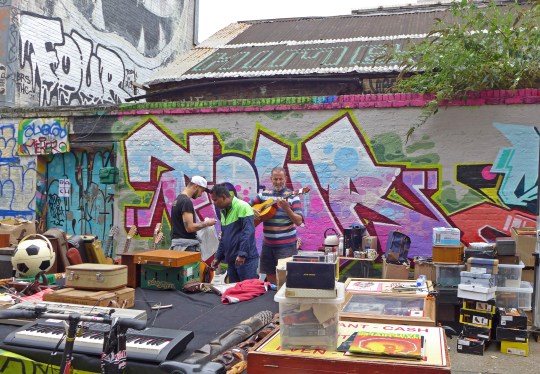
beautiful graffiti
At minimum, stop by for dinner. That was my initial foray into Shoreditch. London is very old place. Shoreditch has been through several centuries of history and its star has risen and fallen. These days it is definitely on the rise. London is one of the great cities of the world. I have lost count of the number of times I have visited but it is so vast in both geographic size and scope of things to see and do that there are still plenty of things I have not yet done.
The first time I set foot in the city of London was 28 years ago. I got my first passport to visit my boyfriend who was travelling through Europe on an extended trip I couldn’t afford but I discovered the airfare to London wasn’t too bad so I could buy a backpack and make a short visit since we could sleep on the sofa at his Australian friends’ flat in Earl’s Court. Back then, it was best to just stick to an English cooked breakfast and fish and chips. Pretty much everything else was cooked to death and tasted a little like cardboard.
Luckily, I have found lots of reasons to continue to return to England’s capital so saw the rise of British cuisine first hand. For a long time now, I have been fortunate to have at least one friend living in London and it makes me an especially privileged tourist. We’ve been going to Shoreditch for dinner for a few years now so I decided it was time to see if I could STAY in Shoreditch and expand my knowledge of the city.
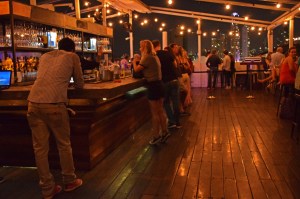
There are a few options. I decided to stay at the Hoxton. I would highly recommend it if you are comfortable with hipsters 😉 It’s very lively. They have done a
hangin at the hoxton
good job of being part of the neighborhood while catering to tourists and it’s packed on the weekend. I spent some time with my friends but was also at the hotel alone at points so could go into observation mode.
exploring the ‘hood
It was quite hilarious. In my normal life, I don’t spend a lot of time with hipsters so had not appreciated how little individuality there was. Practically everyone looked the same, especially the men. For sure, curated facial hair, often a man-bun. Expensive sneakers with little personality. Untucked shirt, invariably white but possibly black. Skinny jeans. It was a little creepy, like looking at a version of youth programmed as Stepford Wives.
While the concept of individuality may have gotten a little lost, there was a lot to like once you indulged in conversation. It’s a great bolthole from which to experience Shoreditch and environs.
We’ll continue the Shoreditch adventures… and eventually I will write more about London… but to get you started I am going to defer to TimeOut. I can vouch for Lyle’s and Andina. I have been using TimeOut guides for most of my adult life. I can’t remember if I discovered it in London or in New York City. Like so many things, it has gone from cool entrepreneurial quirk to ubiquitous corporate presence but it’s still one of the best resources for travellers who like the path less travelled…
Category:
life philosophy, social commentary, travel stories
Tagged with: