
the chinese are coming ;)
I was very lucky that I happened to be living in Europe in the late 90’s so getting to Prague was not difficult. We stayed in a guesthouse that still reeked of Communist architecture and the city was still coming to terms with the concept of a market economy. Prague is one of the most beautiful cities in the world and, at that time, I felt like I had wandered into a Brothers Grimm fairy tale. We happened to be there on the night in spring where people hike up a hill to scare off witches… something to that effect anyway 🙂 Witches figure into mittel europa tradition a lot. There was also bonfires and beer, which I think might have been the more important part of the tradition. I just remember how magical it was to be walking through the forest late at night full of moody atmosphere and torches.
This time I arrived in Prague to rain so spent a day wandering the city in subdued lighting and drizzle, which somehow seemed to fit the city. Prague has had a complicated history and it feels melancholy. It’s a dramatic place and it feels right that a place like this would elect a writer and philosopher as its first President (in direct contrast to a President who doesn’t even read books 😉 You can experience Prague on several levels.
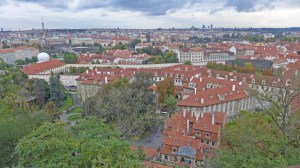
climbing the hill for a better view
It’s a pretty place with a castle, some museums, a cute Old Town and lots of gorgeous buildings so you can treat it like Disneyland and just follow the other tourists and take photos of the pretty things. Prague has centuries of fascinating history, though, so you can definitely dig deeper.
According to legend, Princess Libuše had a vision of Prague long before any building began. It started with the castle. It was built around 880 and is one of the largest castles in the world. It is on a hill and a medieval fortress in addition to being a castle. Later Prague became a major trading hub and, as with the rest of middle Europe, a jewel to be fought over and traded. For tourists, the castle is one of the main draws. There weren’t many people there in 1999 but I understood that had all changed – and that was an understatement.
One of the big changes for tourists in the past decade has been the steady rise of the Chinese economy. I was in China in 2008. Back then, most people had very few holidays and travel was mostly to other parts of China. Since I travel to all sorts of destinations, I see who the tourists are. It’s very interesting. In Cambodia, there are a lot of French tourists and hardly any Americans. The Chinese travel the way the Japanese did decades ago – on group tours with someone who speaks their language.
It’s maybe partly the group tour aspect but they seem to be interested in famous stuff. I made the mistake of going to Galeries Lafayette in Paris during Golden Week, which is a Chinese holiday week. What was fascinating is that Printemps is only a short walk away (and an equally impressive Parisian department store) but the Chinese tourists were all at Galeries Lafayette. Based on my observations, I suggested to my friend that we visit the castle in the afternoon when the tour groups had already left. It proved to be a winning strategy.
The other really big draw in Prague is the astronomical clock. It was built in 1490 and was a technical marvel of its day. It still chimes on the hour so it’s wise to
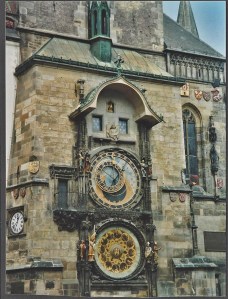
an amazing way to tell time
arrive early if you want a photo without other people’s heads in it. It’s in the Old Town Square, which is charming. If you want to get some good photos or soak up its medieval atmosphere without being jostled, get up early when it is surprisingly empty. I also discovered that, if you head off the main routes, the streets are quiet. It seems like a lot of tourists in Prague are on a group program that follows the main routes to the key sites. You’ll want to see them too but it also means there is another Prague that is as yet undiscovered.
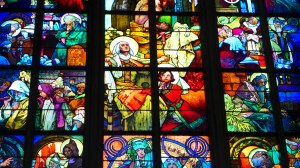
worth the wait
St Vitus Cathedral is the other highlight. It’s part of the visit to Prague Castle. When we arrived, the line was gigantic so we checked out some other parts of the castle first and were able to enter with barely a wait. As more of us become tourists, you need a strategic plan 🙂
The final “must see” is Charles Bridge. It was commissioned in 1357 and is a massive stone bridge across the Vltava River linking the castle to thriving medieval Praha. Even with the tourist mobs, it’s a wonderful place to stroll. There are lots of artists and artisans selling their wares and you can get some very cool souvenirs for a very reasonable price. It is also scattered with statues of saints and glorious views of the river and the ancient city.
These sights take you back to medieval times and it’s easy to imagine the Brothers Grimm are at one of the local taverns and you could join them for a beer. There are very few places in the world where you can truly imagine you are part of a different century. For that reason alone, Prague deserves a visit. What makes it even more special is the quirky nature of Czech history and the off the beaten path adventures you can enjoy once you’ve seen the highlights and want to be a traveller instead of a tourist…
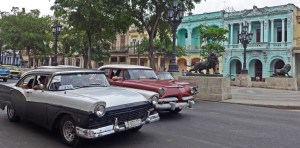

 life on planetm
participating in the local economy…
It is always my goal to try and help the local economy in all countries that I visit. The easier it is to navigate, the easier it is to acquire information and meet locals so that you can get a better sense whether you are impacting the lives of individual citizens or governments or giant corporations. Communism is in theory about the people so should make it easier to boost the bank accounts of ordinary people through tourism but it is generally the opposite.
It’s hard to know what is controlled by the government, advertising is suppressed and not everyone is comfortable expressing an honest opinion. That doesn’t mean you give up though, just that you have to try harder. As I earlier expressed, I really wished I had done more homework before I arrived in Havana and highly encourage bringing a guidebook!
Of course the other thing that works in every place is to chat with locals. You might meet some on the Malecon. It’s a seafront promenade that stretches for seven kilometres. Personally I found it a little underwhelming and having to navigate several lanes of crazy Latin drivers without traffic lights just made me feel as though I was back in Pompeii risking my life on the roadway so I could catch the bus back to Rome. There is a lot I like about Latin people but their driving habits are not in that category. Nevertheless, as long as no one plows you down getting there, it offers a great view of Havana.
great atmosphere
I preferred to meet my locals in Old Havana where the traffic is mostly on foot. The most fascinating conversation I had was when I was buying souvenirs on Calle Obispo and met an American who was relocating to Cuba. He was a big fan and an entertaining guy. A liberal Republican! He had lots of interesting views involving a few conspiracy theories. Much to like. Much to question 🙂 I had been lured in by a young Cuban entrepreneur promoting his wares on the street so felt I was supporting the local economy.
Also spent some time at Sloppy Joe’s, a restoration project of a Havana institution. It is definitely new Cuba and an interesting
hipster cuba 🙂
counterpoint to all the crumbling buildings.
The other thing I would recommend is taking a shared taxi. I didn’t do it on purpose. The taxi to Plaza de Revolution was so expensive I thought I would walk back but instead just managed to get lost in Nuevo Vedado. It was illuminating though. I found a hotel where Cubans would stay rather than foreigners. Of course, that also meant the guy at the front desk couldn’t call me a taxi. It was Mother’s Day so taxis were at a premium.
I discovered that it appears the street names in Vedado are marked on stones at ground level rather than signs above eye level… why it is easy to get lost. Since I had to find my own taxi, I attempted to figure out how to get to a main street and managed to get back to Avenida de los Presidentes, a place I knew well from my earlier experience lost in Havana. It wasn’t easy to find a taxi that wasn’t filled with passengers but finally a car stopped. I had read about the shared taxis so figured it was better than being lost.
It was a great insight into the real Cuba. There are two currencies – local pesos and tourist pesos (which are equivalent to a US dollar). I had been living in the tourist peso economy and the taxi driver was quoting the fare in local pesos. The other passengers were lovely and helped me to figure it all out and I think we both won. It cost me almost nothing and the driver got a crazy tip.
I would definitely encourage you to seek out the real Cuba and support the new entrepreneurs. One of the easiest ways is dining at paladares. You will need to seek them out as they are typically on the second floor and advertising is very minimal. I used my guidebook and discovered a great one and a classic one.
classic cuban cuisine
The classic one was El Gijones at Prado #309. You can look out on the Prado and eat a very reasonably priced meal of pork, rice and beans. Classic Cuban fare.
Even better is to seek out Paladar Los Mercaderes (Mercaderes #207). It’s a charming, romantic space complete with
capitalist cuba 😉
fresh rose petals on a marble staircase. Some equally charming young men were at street level trying to lure me in but I told them I had already selected it as my dinner location. I was really early so got incredible service and took my server’s suggestion to splurge on the lobster in coffee sauce. It’s a Cuban splurge so not too bad on the budget and it was delicious!
It also allowed me to have some intriguing conversations with young Cubans. Coming of age in Cuba in the 21st century is definitely an interesting experience. They have grown up with a rich culture and a history longer than almost any in the New World but capitalism is seductive and they sense the need for change. You can’t begin to debate the merits of capitalism or socialism in under a half hour but I told them Cuba was trending and their lives would be memorable… most memorable for me… they didn’t know what trending meant… why you need to see it now 😉
Category:
social commentary, travel stories
Tagged with: