
going native…
Staying at the Hotel Parque Central put me firmly in gringo tourist land, an obvious mark flush with hard currency. Tourism has turned Cuba into a fascinating hybrid culture with lots of unexpected consequences. There is idealistic merit in having all jobs paid a similar wage but, in 21st century capitalism, the approach is completely opposite. Cuba’s model might work if it could exist as a self-sufficient closed society but instead it had to let in the rest of the world in limited ways to survive.
The unexpected consequence is that it might be more lucrative in 2017 to drive a taxi than to be a doctor. How to behave as a tourist is complicated but you will definitely get constant sales pitches if you stay in the tourist ‘hood. I always like to try and understand the places that I visit and one of the best ways to get familiar with unfamiliar surroundings is to walk.
Luckily Havana is very safe so you can wander quite freely and it’s likely you can find a taxi to get you back to the hotel if you get too ambitious.
My first big Havana adventure was supposed to result in photos of Plaza de Revolución but everything unfolded in an entirely unexpected way. According to the map, I could just walk in a straight line along one of the main streets until I reached Vedado. Vedado (`forbidden`) was originally a buffer zone to protect the city from pirate attacks. In 1859, a plan for urban expansion was created with strict building codes that established a grid with broad sidewalks, gardens and parks. There are few tourist sites but it is a great way to experience middle class Cuba.
It is also the home of the University of Havana. I stumbled upon the university by accident rather than design but it is one of the oldest universities in Latin America with gorgeous classical buildings and historical significance. I stopped to take a photo of the university entrance and that was how I met Rolando. He said that the views were better from inside. Since he is a Spanish professor at the university, he took me on a grand tour.
Unfortunately, it`s not an official tourist activity so you will just have to get lucky. It`s definitely good to talk to locals to get a better understanding of the complexity that is modern day Cuba.
I ended up spending a few hours with Rolando. First, he toured me around the university, including the Museo Anthropologico Montane, the Saracen armoured car captured in 1958 by students in the fight against Batista and the balcony from which Castro delivered speeches to incite students toward revolution. Then he showed me the room Castro rented when he was a student. He explained the ration system for food and took me into one of the stores where Cubans can exchange coupons for food items.
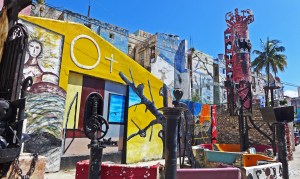
creative recycling
Rolando then took me to a cool neighborhood filled with impromptu performers and art made from stuff that would likely go into a landfill in North America. Our final venture was a cocktail based on an ancient recipe in a tiny, funky bar. Latins love sugar a lot more than me so it wasn`t really my thing but the experience was memorable.
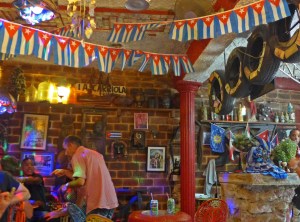
off the tourist path
He had to go to work so gave me directions to the Plaza de Revolución but I never figured out Vedado as the streets are not marked in a normal way. It`s a pleasant place to get lost so I just went with it and finally found a major street that I could locate on the map so that I could eventually make my way from la Avenida del Presidentes to Calle 23, also known as La Rampa, and one of the most famous streets in Havana.
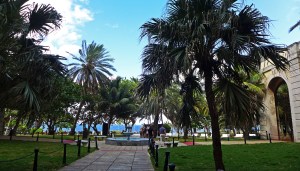
living la dolce vida
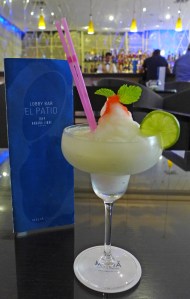
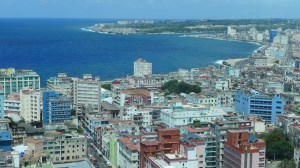
That`s where I rewarded my hours of wandering on foot through Havana with the beautiful frozen daiquiri previously mentioned. It also allowed me to get a good overview of Havana and figure out where the Hotel Nacional was by looking out the window! This time I counted the streets very carefully and make it to the new destination without any extra steps. The Hotel Nacional was built in 1930 as a refuge for wealthy Americans. Since it has hosted a cornucopia of famous people and featured heavily in the history of the mafia.
It also features a delightful terrace where you can sip an overpriced drink and look out at the ocean and much of Havana. By that point, I was content to head back to tourist land and pay for a taxi. All the wandering though made me bold and encouraged me to delve further into the real Cuba…


 life on planetm
viva la revolution!
It is strange and somewhat disconcerting to be a tourist in a Communist country. Of course, you can just follow a tourist guide around and not think about it or stay in a posh resort that is wholly capitalist despite the national politics. I always like to try and understand a place when I visit to the extent my few days immersed in the local culture will allow.
drifting through havana
Since I only had about five full days in Cuba, I decided to just stick to Havana so that I could try and get a good sense for it and save the rest of Cuba for another visit. There is plenty to do – and think about – in Havana so I was never bored. I also went on these crazy walks all over Havana that lasted for hours and frequently resulted in me being lost for some portion of the walk. The wonderful part of that was that I discovered Havana in a way I never would have just speeding by in a pretty refurbished automobile from the era of Trump’s fantasy America.
I did feel that I should do that at least once, and since I had gotten lost trying to walk to Plaza de Revolución, it seemed a
an eerie place
good case for a fancy ride through Havana. I would definitely recommend at least one ride in a classic car. Mine was very expensive compared to everything else in Cuba but, as a gringo, I just accepted I was contributing to the economy.
Plaza de Revolución is a lot different in person that it looks in photos. There is the fancy metalwork saluting Fidel and Che, which is a compulsory tourist photo. The square is gigantic and generally eerily empty. The military presence is very obvious and you realize you are in a police state. It feels like someone is watching from a hidden camera every moment. There are lots of signs marking where you can no longer wander.
welcome to china!
Communism and other forms of dictatorship make me nervous. I was relieved to get out of the Plaza de Revolución and to another part of Cuba that felt hopeful and festive. When I was in China, my hotel was close to Tiananmen Square and, despite being a major hosting venue for the Olympics, which had just ended, no taxi driver seemed capable of finding it so I spent a lot of time in Tiananmen Square. It is an unnerving place to be deposited. Mao is always looking at you and there are plenty of dudes with rifles milling about. One of the most bizarre sights was the soldiers standing guard in front of a giant display of the silly Olympic mascots. There should have been a sign saying “Welcome to China! It’s complicated.”
All countries are complicated but Communist countries increase the complexity by an exponential degree. Theoretically, all this communism is FOR the people and offers them a better life than the capitalist pigs would have allowed. But it’s never really gone down like that. Every supposedly Communist state is a little different. ALL love propaganda! All are comfortable suppressing the truth, controlling the media and rewriting history. Visiting a Communist country really makes one appreciate the freedoms and benefits of democracy even if not all of its attributes are sublime.
When I was in China, it was entertaining to read the history of Shanghai through the Chinese government’s eyes. In Cuba, you can get the same experience by visiting the
ya gotta love propaganda 😉
Museo de la Revolución. It is located in the former Presidential Palace so worth visiting just for the architecture. You will certainly learn about the Cuban Revolution. You won’t learn much beyond that, though, and it’s all glory and sacrifice and the 1960s. Just another aspect of Cuba that feels like a time capsule.
fidel is watching you…
It’s important, though, to note that young Castro was a noble guy. He did some good stuff. It’s easy to go communism bad, capitalism good, but it’s not at all that simple. Probably why the vast majority of the people who score high on happiness and quality of life on those international indices live in socialist countries. The best system includes elements of both.
And Castro and team did some remarkable things in Cuba. They defeated the United States of America! They got rid of the mob and the casino culture that had overtaken the economy. They sent young disciples out to rural Cuba to teach everyone how to read so that Cuba now has one of the highest literacy rates in the world. They also have free education and healthcare and some basic food is provided by the state. It’s an idealistic concept that would have appealed to the very young men and women who masterminded the Cuban revolution.
The tough part, though, is how to sustain that kind of system and how to be able to interact with a world that doesn’t share the same system.
the iconic che
The original system was more crazy fever dream than well-reasoned new political and economic philosophy. As an example, I learned that Che Guevara was appointed President of the National Bank of Cuba and Minister of Industry in addition to being in charge of Agrarian Reform. OK, first, TOO many major jobs. Second, SERIOUSLY, who appoints a dude who’s a doctor and a guerilla war expert to run the money stuff???
I would encourage you to go to Cuba and check it out for yourself. Go with an open and inquisitive mind. There are some good ideas there. There is a lot of idealism. There is a lot of pride. There is also naivety. Cuba is an example of incredible idealistic ideas brought to fruition – but it is also a cautionary tale that it’s really important to have a plan that’s sustainable and pragmatic enough that your revolution will actually achieve the ideals you hoped it would for the long term. The hardest part begins the day after the victory parade…
Category:
social commentary, travel stories
Tagged with: